If you’ve ever sat at a Teen Patti table and heard someone say “main blind khel raha hoon” while everyone else nodded like it was obvious, but you had no idea what that actually meant — you’re not alone. Blind and seen play is one of the first things that confuses new players, and honestly, blind vs seen in teen patti it’s also one of the most important parts of the entire game.
Table of Contents
If you’ve ever sat at a Teen Patti table and heard someone say “main blind khel raha hoon” while everyone else nodded like it was obvious, but you had. Understanding blind vs seen in Teen Patti is one of the first things that confuses new players, and honestly, it’s also one of the most important parts of the entire game.
Once you understand how blind and seen betting actually works, a lot of the strategy behind Teen Patti suddenly makes sense. This guide breaks it down clearly, with examples, blind vs seen in teen patti so you’ll never have to awkwardly nod along again.
What Does “Seen” Mean in Teen Patti?
A seen player is simply someone who has picked up their three cards and looked at them. Once you’ve seen your cards, you have information — blind vs seen in teen patti you know whether you’re holding a strong hand like a Pair or a Sequence, or a weak High Card hand that’s probably not worth chasing.
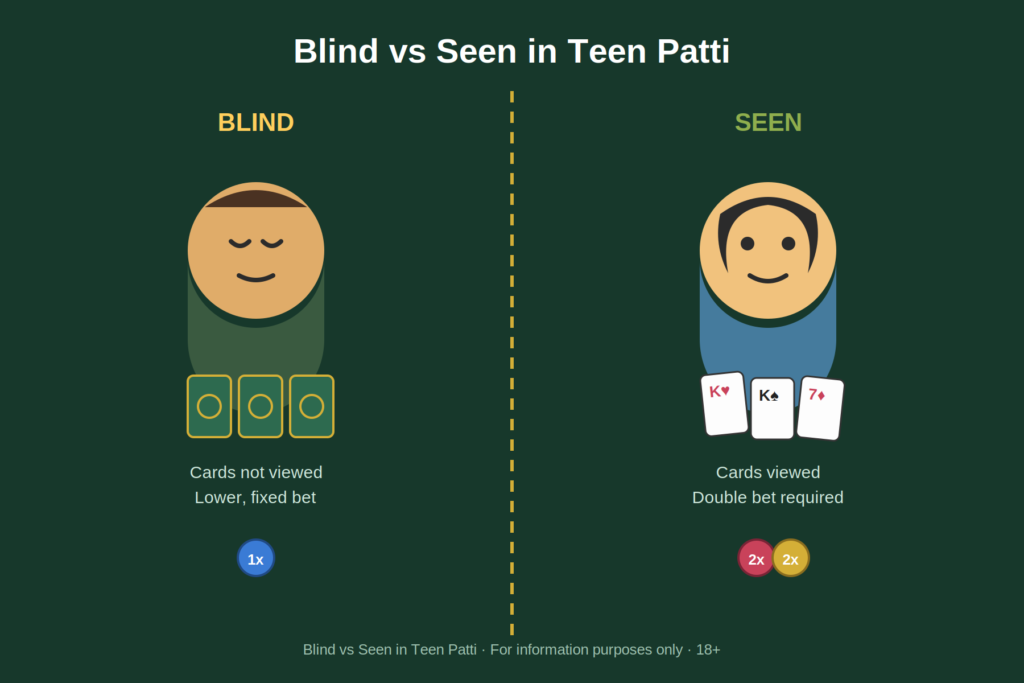
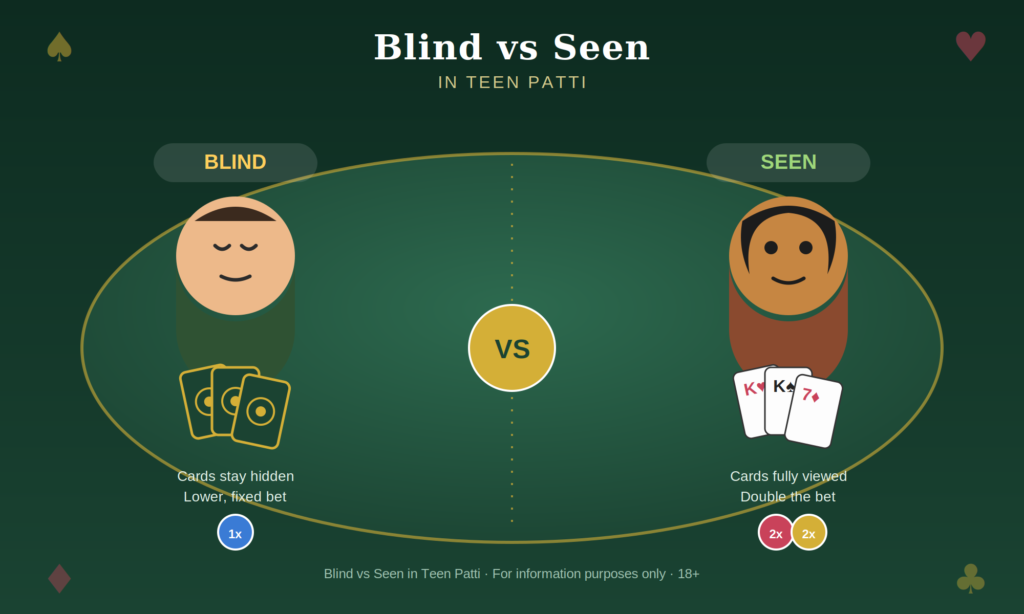
Because seen players have this extra knowledge, the game requires them to bet more to balance things out. In most versions, a seen player’s minimum bet is double what a blind player bets.
Example: If the current blind bet is one chip, a seen player must bet at least two chips to stay in the round.
What Does “Blind” Mean in Teen Patti?
A blind player keeps their cards face down the entire time, without looking at them at all. This might sound risky — and it is, in a sense — but it comes with a built-in advantage: blind players bet at a lower, fixed rate, and they also keep opponents guessing. blind vs seen in teen patti
Since nobody, including the blind player themselves, knows what they’re holding, a blind bet carries zero information. Other players can’t read anything into it beyond pure confidence or habit, blind vs seen in teen patti which is exactly why some experienced players deliberately stay blind for several rounds as part of their strategy.
Example: If the boot amount was one chip, a blind player continues betting one chip per turn, without ever checking their cards, for as long as they choose to stay blind.
Blind vs Seen in Teen Patti: Breaking Down the Difference
| Factor | Blind Player | Seen Player |
|---|---|---|
| Knows their cards? | No | Yes |
| Bet amount | Standard (lower) | Double the blind bet |
| Information available | None | Full knowledge of own hand |
| Common strategy use | Bluffing, staying unpredictable | Playing based on actual hand strength |
Can You Switch Between Blind and Seen?
Yes. A player can start the round blind and choose to look at their cards at any point during their turn — blind vs seen in teen patti this is called “showing” your own cards to yourself, not to be confused with a “show” between two players at the end of a round.
Once a blind player looks at their cards, they immediately become a seen player for the rest of that round, blind vs seen in teen patti and their bets switch to the higher seen-player rate from that point forward.
There’s no way to go back to blind betting once you’ve looked — the decision is permanent for that hand.
Why Would Anyone Stay Blind on Purpose?
This is where Teen Patti strategy gets interesting. Staying blind isn’t just for players who are too nervous to look at weak cards — blind vs seen in teen patti it’s a deliberate tactic used by experienced players for a few reasons:
1. Lower betting cost. Blind bets are cheaper, so staying blind longer means risking less per round while waiting to see how other players behave.
2. Total unpredictability. A blind player’s bet carries no information at all. Other players can’t tell if they’re sitting on a Trail or complete nothing, which can make opponents cautious.
3. Psychological pressure. Confidently raising while blind can intimidate seen players who know exactly how weak their own hand is, blind vs seen in teen patti sometimes pushing them to fold hands that were actually fine.
4. Pure luck plays. Some players enjoy the thrill of playing an entire hand blind just for the unpredictability of it, win or lose.
Why Would a Player Choose to Look Early?
On the flip side, looking at your cards early also has clear advantages:
- You can fold immediately if your hand is weak, avoiding unnecessary losses.
- You can play more aggressively with confidence if you’re holding a strong hand like a Color or Sequence. blind vs seen in teen patti
- You remove the guesswork from your own decisions, even though your bets become more expensive.
Most beginners are better off playing seen until they’re comfortable with hand rankings and betting patterns — blind vs seen in teen patti blind play is a more advanced tactic that works best once you understand how opponents typically behave.
A Simple Example Round
Imagine four players: Bilal, Sana, Omar, and Ayesha.
Bilal decides to stay blind from the start. Sana looks immediately and sees a weak High Card hand, so she folds right away. blind vs seen in teen patti Omar stays blind as well, matching Bilal’s bets. Ayesha looks and finds a strong Pair, so she raises confidently.
Now Bilal and Omar, both still blind, have to decide whether to match Ayesha’s higher bet or finally look at their cards. Bilal matches it blind, staying unpredictable. Omar decides to look — blind vs seen in teen patti he finds a weak hand and folds immediately, now playing it safe as a seen player who knows the truth.
It comes down to Bilal (still blind) and Ayesha (seen, confident in her Pair). Bilal eventually calls for a show. blind vs seen in teen patti Cards are revealed — Bilal was holding a Trail the entire time, and wins the pot despite betting blind throughout the hand.
This is exactly why experienced players treat blind betting with caution — you genuinely never know what’s behind it.
Common Mistakes Beginners Make
Mistake 1: Assuming blind players are always bluffing.
Sometimes they genuinely have nothing and are just hoping to get lucky. Other times, like Bilal in the example above, blind vs seen in teen patti they’re sitting on a monster hand. Blind betting gives you zero reliable information either way.
Mistake 2: Looking too early out of impatience.
New players often look at their cards almost immediately out of curiosity, blind vs seen in teen patti missing the strategic value of staying blind even for a round or two.
Mistake 3: Forgetting that seen bets cost double.
Some beginners look at their cards, then get surprised when they’re required to bet more than they expected on their next turn.
Where Does the Blind Rule Come From?
The blind-betting concept isn’t unique to Teen Patti — it traces back to the game’s British ancestor, Three-Card Brag, where “blind” betting existed as a core bluffing mechanic long before Teen Patti took shape in South Asia. blind vs seen in teen patti The idea is simple in any card game: the less information you reveal, the harder you are to read.
What makes Teen Patti’s version interesting is how deeply the blind/seen split became tied to betting cost. In many other card games, choosing not to look at your cards doesn’t come with a financial discount — but in Teen Patti, blind vs seen in teen patti it does, which turns blind play into a genuine strategic tool rather than just a dramatic flourish.
How Blind Betting Changes the Pace of the Game?
Experienced players will tell you that a table full of blind players moves very differently from a table full of seen players. When most players stay blind, betting stays low and rounds move quickly, since nobody is making informed decisions — it’s mostly a waiting game to see who looks first. Once one or two players switch to seen, the dynamic shifts immediately.
Bets double, decisions get more calculated, and the round often speeds toward a show instead of dragging on. Recognizing this shift is a small but useful skill: if you notice several players going “seen” early, it usually means the group is playing cautiously, and bluffing blind for too long becomes riskier since fewer players are left to bluff against. blind vs seen in teen patti
According to Wikipedia’s entry on Three-card brag, blind betting was already a core mechanic in Teen Patti’s British ancestor game, long before it became part of South Asian card culture.
Players Blind Professional Prefer versus?
Ask a handful of regular Teen Patti players which style they prefer, and you’ll get mixed answers — and that’s exactly the point. There’s no universally “correct” choice between blind and seen; it depends entirely on table dynamics, how well you know your opponents, and how much risk you’re comfortable with.
That said, a few general patterns tend to hold up:
- Smaller, familiar groups (family, close friends) tend to lean toward seen play, since bluffing has less room to work when everyone already knows each other’s tendencies.
- Larger or mixed groups with unfamiliar players often see more blind betting early on, since nobody has enough information yet to bluff effectively while seen.
- Players low on chips sometimes deliberately stay blind longer, since the lower betting rate stretches their chips further while they wait for a strong moment to switch.
- Aggressive players often go seen quickly specifically so they can raise hard and pressure others into folding, using confidence rather than secrecy as their weapon.
None of these are strict rules — they’re just common tendencies you’ll start noticing the more you play.
Blind and Seen in Side Shows
One detail that trips up a lot of newer players: side shows only work between two seen players. If you’re blind, you cannot request or accept a side show, since the entire point of a side show is privately comparing actual card values between two players — something that’s impossible if one person hasn’t even looked at their own hand.
This means that if you’re planning to use side shows as part of your strategy, staying blind for too long actually limits your options. At some point, if you want to directly compare hands with a specific opponent rather than waiting for a full show, you’ll need to look at your cards first.
Frequently Asked Questions
Does a blind player ever have to reveal their cards?
Only if they reach a final show with another player — otherwise, their cards stay hidden the entire round, win or lose.
Is it better to play blind or seen as a beginner?
Seen is generally safer for beginners, since it lets you make informed decisions and fold weak hands early.
Can two blind players have a side show?
No, side shows are only allowed between two seen players, since it involves comparing actual card values.
What happens if everyone stays blind the whole round?
Betting continues at the lower blind rate until it’s down to two players, who can then request a show to settle the hand.
Why do seen players bet double?
Because they have information blind players don’t — the doubled bet balances out that advantage.
Final Thoughts
Blind and seen betting is one of the simplest rules to explain, but one of the deepest when it comes to actual strategy. Once you understand that blind betting isn’t just a passive choice but an active tactic experienced players use deliberately, the entire rhythm of a Teen Patti game starts making a lot more sense.
If you’re still getting comfortable with the basics, check out our complete beginner’s guide to Teen Patti rules and our breakdown of Teen Patti hand rankings to pair with what you’ve learned here.
Disclaimer: This article is written for educational and entertainment purposes only. We do not promote or facilitate real-money gambling of any kind. Readers must be 18 years or older.
Pingback: 3Patti Terms Explained: Boot, Chaal, Blind, Pack and More - webnilo.com