Why does a Pair of Queens feel unbeatable in one round and completely useless in the next? Every Teen Patti table has a player who swears they were “due” a good hand, teen patti probability and another who folds a perfectly decent pair because someone raised loudly. Most of these arguments could be settled with a little teen patti probability, teen patti probability because the game is built on numbers that rarely change.
This guide gives you those numbers in plain language. You will see how often each hand appears, your exact chance of winning a head-to-head showdown, and how fast that chance drops when more players join the table. Some of the figures are standard, but the winning chances come from my own calculations, explained at the end so you can judge them yourself.
What Is Teen Patti Probability?
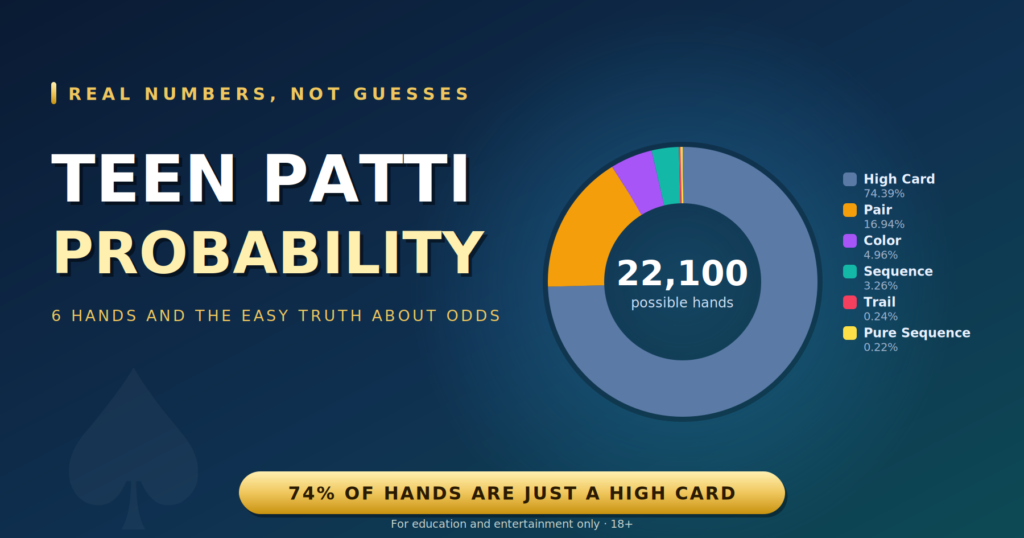
Probability is simply how often something happens out of all the ways it could happen. In Teen Patti, you receive three cards from a 52-card deck. The number of different three-card hands is 22,100 (a calculation called “52 choose 3,” teen patti probability explained on Wikipedia’s binomial coefficient page). Count how many of those hands make a Trail, a Pair and so on, and you have the probability of each.
One caution before we start. Probability describes what happens over many hands, not what will happen in the next one. The deck has no memory, so nobody is ever “due” a Trail. They are not a system for winning.
Teen Patti Probability of Every Hand
Here is how often each hand shows up in a standard game with no jokers:
| Hand | Combinations | Chance | Roughly 1 in |
|---|---|---|---|
| Trail | 52 | 0.24% | 425 |
| Pure Sequence | 48 | 0.22% | 460 |
| Sequence | 720 | 3.26% | 31 |
| Color | 1,096 | 4.96% | 20 |
| Pair | 3,744 | 16.94% | 6 |
| High Card | 16,440 | 74.39% | 1.3 |
Notice that nearly three out of four hands are just a High Card. That is why even a modest Pair feels like a decent result. teen patti probability If you need a refresher on what each hand looks like, our hand rankings guide shows an example of every one.
Why a Sequence Beats a Color
Many beginners think a Color (three cards of one suit) should outrank a Sequence. The numbers explain why it does not. There are 720 possible Sequences but 1,096 possible Colors, so Colors are more common, and the rarer hand ranks higher. The same logic puts Trail at the top: only 52 hands can make one.
Your Chance of Winning Heads-Up
Now for the question every player really asks: “Is my hand good?” Here is the exact chance each sample hand beats one random opponent, calculated by comparing it with every possible hand the opponent could hold. Ties are below 0.15% for every hand, so I have left them out.
| Your hand | Chance to win |
|---|---|
| A♠ K♥ J♦ (best possible High Card) | 74.2% |
| K♠ 9♥ 4♦ (typical High Card) | 49.3% |
| 9♠ 7♥ 3♦ (weak High Card) | 10.2% |
| 2♠ 2♥ 7♦ (lowest kind of Pair) | 74.3% |
| 8♠ 8♥ 7♦ (middle Pair) | 82.4% |
| A♠ A♥ 4♦ (top Pair) | 91.1% |
| K♥ 9♥ 4♥ (Color) | 94.6% |
| 2♠ 3♥ 4♦ (lowest Sequence) | 96.2% |
| 9♠ 10♥ J♦ (Sequence) | 98.3% |
| 4♥ 5♥ 6♥ (Pure Sequence) | 99.6% |
| 2♠ 2♥ 2♦ (lowest Trail) | 99.7% |
Two things stand out. First, the lowest Pair of all (two 2s) is almost exactly as strong as the best High Card, because both win about 74% of the time. teen patti probability Second, even the weakest Trail loses less than 0.3% of the time, so it is very close to unbeatable.
What Changes at a Real Table
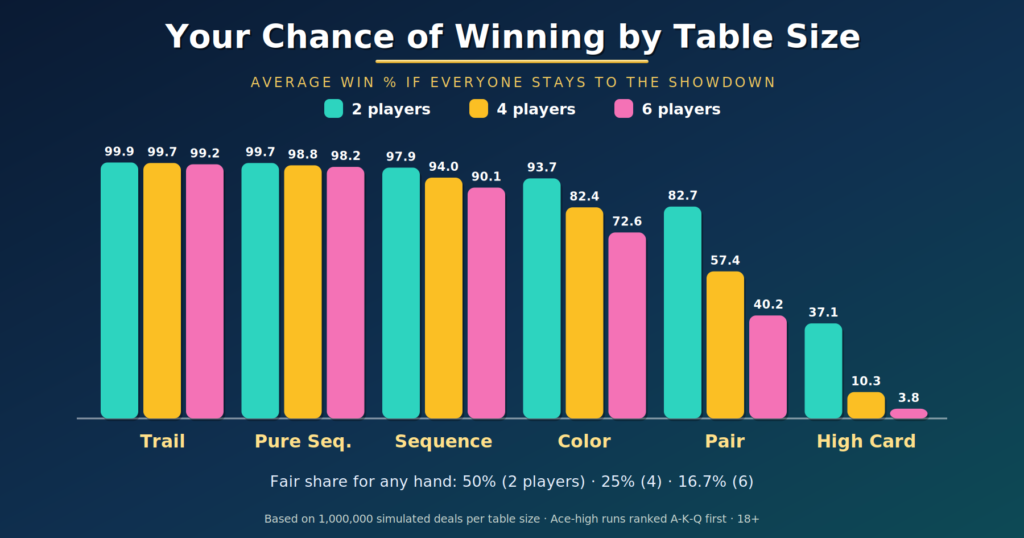
Head-to-head numbers look generous, but a real table has more players. If four or six people all stay in until the showdown, teen patti probability you have to beat all of them, and the same hand wins far less often.
This table shows the average winning chance of each hand type when everyone stays to the end:
| Your hand type | 2 players | 4 players | 6 players |
|---|---|---|---|
| Trail | 99.9% | 99.7% | 99.2% |
| Pure Sequence | 99.7% | 98.8% | 98.2% |
| Sequence | 97.9% | 94.0% | 90.1% |
| Color | 93.7% | 82.4% | 72.6% |
| Pair | 82.7% | 57.4% | 40.2% |
| High Card | 37.1% | 10.3% | 3.8% |
| Fair share for any hand | 50% | 25% | 16.7% |
A Pair is a strong hand heads-up (82.7%) but only slightly better than a coin flip at a four-player table (57.4%). teen patti probability At six players, a Pair wins about 40% of the time, and a High Card wins under 4%.
Five Lessons the Numbers Teach
1. A Pair is only as strong as the table is small. With few players left, it deserves respect. With many, teen patti probability treat it as an average hand.
2. A High Card rarely wins a full table. At four players the average High Card wins about one round in ten. Holding one at the showdown is the exception, not the rule.
3. Expect someone to hold something. The chance that at least one opponent has a Pair or better is 25.6% against one opponent, 58.7% against three, and 77.1% against five. When a six-player table goes quiet and one person raises, that raise is often backed by a real hand.
4. Blind play is a bet on an average hand. Before you look, your hand is a random one, so its expected share equals the fair share in the table above (25% at four players, for example). Looking at your cards gives you information, which is exactly why seen players usually bet double. Our blind vs seen guide explains the trade-off in detail.
5. Players who fold change everything. These numbers assume everyone reaches the showdown. In real games, weak hands fold early, so the players who stay in tend to hold better cards than average. teen patti probability Your Pair is likely weaker against a player who is still raising than the table suggests. Treat the figures as a baseline, not a prediction.
Probability Myths That Start Arguments
“I haven’t had a Trail all night, so one is due.” The deck is reshuffled every round. Each deal is independent of the last.
“Ace high is a strong hand.” A♠ K♥ J♦ wins 74% heads-up, which is good. But at a six-player table, a High Card hand still wins less than 4% of the time on average.
“A Trail can’t lose.” It can, to a higher Trail. A lowest Trail still loses about 0.26% of the time heads-up, which is rare but real.
“Hands come in streaks.” Streaks happen by chance, and small groups notice them more than they deserve.
“The dealer or seat position changes your cards.” It does not. Every seat receives equally random cards.
How These Numbers Were Calculated
I believe a probability guide should show its work. Here are the assumptions behind the figures above:
- A standard 52-card deck with no jokers (the Joker Teen Patti rules change these odds a lot)
- A-K-Q is the highest Sequence, A-2-3 the second highest, and 2-3-4 the lowest
- Suits are not ranked, so equal ranks in different suits tie
- The heads-up table was calculated exactly, by comparing each hand with all 18,424 possible opponent hands
- The table-size figures come from 1,000,000 simulated deals for each table size, so they may differ from exact values by about a tenth of a percentage point
- Everyone stays until the showdown, with no folding, side shows or blind play
Your house rules may differ, particularly on how A-2-3 ranks, teen patti probabilityand a different rule would shift the Sequence figures slightly.
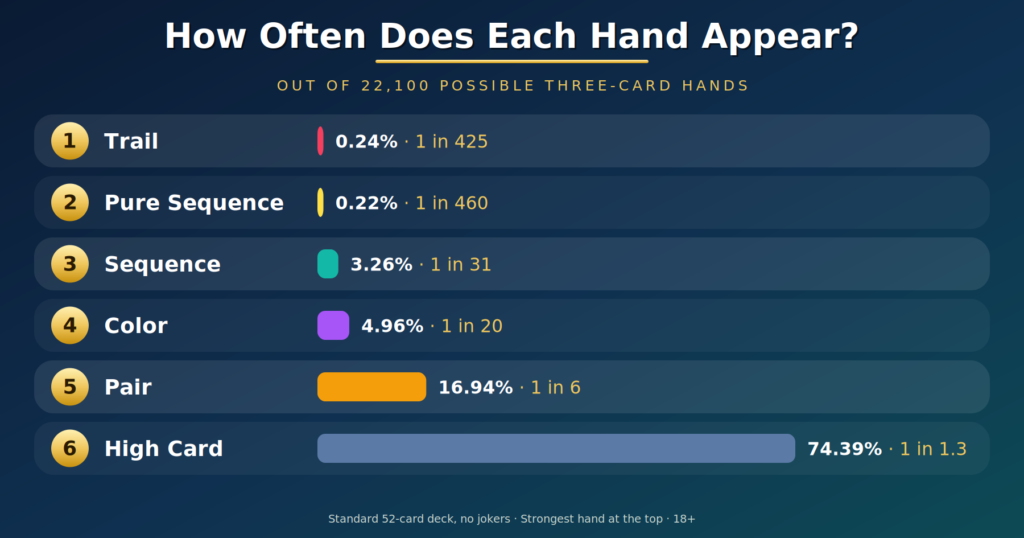
Table of Contents
Frequently Asked Questions
What is the probability of getting a Trail in Teen Patti?
Exactly 52 of 22,100 hands, which is about 0.24% or roughly one hand in 425.
What is the probability of a Pure Sequence?
Exactly 48 of 22,100 hands, about 0.22%. It is slightly rarer than a Trail, even though a Trail ranks higher in some other card games.
Is a Pair a good hand in Teen Patti?
Heads-up, yes (74% to 91% depending on the Pair). At a full table, it is only average.
Can probability help me predict the next hand?
No. It explains how often hands appear over time, but every shuffle is independent.
Do the odds change in other variations?
Yes. In Joker Teen Patti, wild cards make strong hands far more common, which is why a Pair becomes much weaker there.
Final Thoughts
Teen patti probability turns many table arguments into simple arithmetic. A Pair is excellent in a duel and ordinary in a crowd, a High Card rarely wins a busy table, and no hand is ever “due.” Understanding that helps you enjoy the game more, because you stop blaming bad luck for what the numbers already predicted.
If you want to keep learning, start with our complete beginner’s guide to Teen Patti rules, then see how the game compares in Teen Patti vs Poker. And if you plan a family evening, our guide on how to host a Teen Patti night covers the setup.
Disclaimer: This article is written for educational and entertainment purposes only. Probabilities describe long-run averages and do not guarantee any result. We do not promote or facilitate real-money gambling of any kind. Readers must be 18 years or older.