If you’ve played a few rounds of Teen Patti, you’ve probably heard someone at the table ask for a “side show” and watched two players quietly compare cards while everyone else waited. If you weren’t totally sure what was happening, you’re not the only one — teen patti side show rules side show is one of those rules that experienced players use constantly but rarely explain clearly to beginners.
Once you understand teen patti side show rules properly, you’ll notice it’s actually one of the most useful tools in the game for speeding up a round without waiting for a full showdown. This guide walks through exactly how it works, when you can use it, and the small details that trip people up.
What Is a Teen Teen Teen Teen Teen Teen Teen Teen Teen Teen Patti?
A side show is a request made by a player to privately compare cards with the player who bet immediately before them, rather than waiting for the entire table to fold down to a final two-player show. teen patti side show rules If the requesting player’s hand is weaker, they fold immediately. If it’s stronger or equal, the other player folds instead.
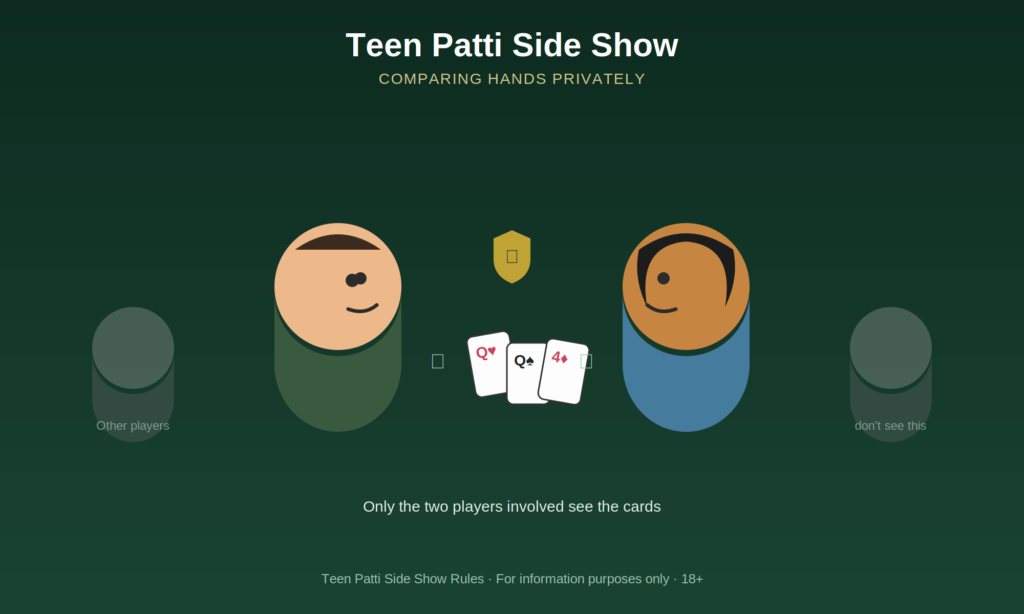
It’s essentially a shortcut — a way to settle a mini-confrontation between two specific players without dragging the whole table through more rounds of betting. teen patti side show rules
Example: If Ali bets, and then Sara (next in turn) wants to request a side show, she’s asking specifically to compare hands with Ali, not with anyone else at the table.
The Core Teen Patti Side Show Rules
Here are the essential rules that govern how side shows actually work:
1. Both players must be “seen.”
This is the single most important rule. A side show can only happen between two players who have already looked at their cards. teen patti side show rules A blind player cannot request or accept a side show, since the entire point is comparing actual card values — something impossible if one person hasn’t even looked at their own hand yet.
2. You can only request a side show with the player immediately before you.
You can’t skip around the table and ask a random player for a side show. teen patti side show rules It has to be the player who acted right before your turn in the current round.
3. The player being asked can refuse.
In most versions of the game, the player who’s asked for a side show has the choice to accept or decline. If they decline, play simply continues as normal, with no cards revealed.
4. The loser of a side show folds immediately.
Whoever has the weaker hand in the comparison is out of the round right away — their cards are not shown to the rest of the table, only to the two players involved.
5. In case of a tie, the player who requested the side show typically loses.
Rules can vary slightly between groups, but the most common convention is that ties favor the player being asked, not the one who made the request. It’s worth clarifying this with your group before playing, since house rules do differ here. teen patti side show rules
Why Side Shows Exist in the First Place
Teen Patti rounds can sometimes drag on, especially with several cautious players all betting the minimum just to stay in. Side shows give players a way to resolve direct confrontations early, teen patti side show rules without forcing everyone to keep betting round after round.
Table of Contents
They also add a layer of psychological pressure. If you’re confident in your hand, requesting a side show against a player who’s been betting aggressively can call their bluff quickly — either they fold because they know their hand is weak, or they accept and you find out immediately where you stand.
A Simple Example of a Side Show in Action
Picture four players: Hamza, Ayesha, Bilal, and Noor. teen patti side show rules All four have looked at their cards (seen).
Hamza bets. Ayesha, acting right after him, isn’t confident enough in her hand to raise, but she’s suspicious that Hamza might be bluffing. Instead of betting blindly into the unknown, she requests a side show with Hamza.
Hamza accepts. They privately compare: Hamza has a Pair of 9s, Ayesha has only a High Card hand. Ayesha folds immediately, without revealing anything to Bilal or Noor, who have no idea what either of their hands actually were.
Play continues with just Hamza, Bilal, and Noor, and the round moves forward faster than it would have if everyone had kept betting blindly against each other.
When Should You Request a Side Show?
There’s no fixed rule for exactly when to use this tactic, but a few situations tend to work well:
- You suspect the player before you is bluffing, and you have a moderately strong hand you’re fairly confident in.
- You want information fast rather than spending several more rounds of betting to figure out where you stand.
- The pot is getting large, and you’d rather settle things directly with one player than keep risking more chips against the whole table.
On the other hand, if your hand is weak, requesting a side show against a player you suspect is strong is rarely a good idea — you’re more likely to just confirm you’re behind and lose the comparison.
When Should You Accept or Decline a Side Show Request?
If someone requests a side show against you, you have a choice:
Accept if:
- You’re confident in your hand and want to eliminate a competitor quickly.
- You’d rather resolve the situation now than risk more betting rounds where the pot grows larger.
Decline if:
- You’re unsure about your hand and would rather keep your options open.
- You suspect the requesting player is only trying to pressure you into revealing information through your reaction, even if you decline.
Declining doesn’t cost you anything directly — play just continues as if the request never happened.
Common Mistakes Beginners Make With Side Shows
Mistake 1: Trying to request a side show while blind.
This isn’t allowed under standard teen patti side show rules. You must look at your cards first before requesting or accepting one.
Mistake 2: Thinking you can side show with any player at the table.
It only works with the player who acted immediately before you in the current turn order, not anyone you choose.
Mistake 3: Assuming a side show request is always a bluff.
Some players request side shows specifically because they have a genuinely strong hand and want to eliminate a threat quickly — not just to pressure weaker hands into folding.
Mistake 4: Forgetting that ties often favor the player being asked.
This small detail changes the math slightly when you’re deciding whether a side show request is actually worth it with a borderline hand.
Side Show vs Full Show: What’s the Difference?
It’s easy to confuse side show with the final “show,” but they work differently:
| Factor | Side Show | Full Show |
|---|---|---|
| Who’s involved | Two specific seen players | The final two players left in the round |
| When it happens | Any time during betting | Only when the round narrows to two players |
| Who sees the cards | Only the two players involved | Often revealed to the whole table |
| Can be declined? | Yes | No, it’s mandatory to finish the round |
Understanding this difference helps make sense of why side shows are often described as a mid-round tool, teen patti side show rules while the full show is simply how every round eventually ends.
How Side Shows Affect Overall Strategy
Once you’re comfortable with teen patti side show rules, you’ll start noticing how they shift the way experienced players approach betting. Rather than purely bluffing with raises, teen patti side show rules players use side show requests as a cheaper way to test opponents without committing to a full round of escalating bets.
This also means staying “seen” has an added benefit beyond just knowing your own hand — it keeps the side show option available, which blind players simply don’t have access to. If you’re planning to use this tactic as part of your strategy, looking at your cards earlier rather than staying blind for too long becomes worth considering.
Frequently Asked Questions
Can a blind player ever request a side show?
No. Both players involved must be seen. This is one of the strictest teen patti side show rules and doesn’t vary much between groups. teen patti side show rules
What happens if the side show request is declined?
Nothing changes — the game simply continues to the next player’s turn as normal.
Does the loser of a side show have to reveal their cards to everyone?
No, typically only the two players involved see the cards. The rest of the table just sees that one player folded.
Can you request more than one side show in a single round?
Yes, as long as each request follows the rule of only being made against the player who acted immediately before you.
Do all versions of Teen Patti use the same side show rules?
Mostly yes, though small details like tie-breaking conventions can vary between groups. It’s always worth agreeing on house rules before starting a game with new players.
Final Thoughts
Side shows add a layer of strategy to Teen Patti that a lot of beginners miss entirely in their first few games. Once you understand the core teen patti side show rules — who can request one, when it’s allowed, and how ties are typically handled — you’ll start seeing opportunities to use it yourself, whether to call a bluff early or settle a confrontation before the pot grows too large.
If you haven’t already, pair this with our guide on blind vs seen betting in Teen Patti, since side shows only make sense once you understand that distinction fully.
Disclaimer: This article is written for educational and entertainment purposes only. We do not promote or facilitate real-money gambling of any kind. Readers must be 18 years or older.
Pingback: 3Patti Terms Explained: Boot, Chaal, Blind, Pack and More - webnilo.com